
October 13, 2025
Kiss My Spider Woman

“You know,” says my friend who is a gay man of a certain age, as we stood up at Landmark’s Opera Plaza Cinema following last night’s screening of KISS OF THE SPIDER WOMAN, “I don’t think I have actually seen the musical before. Just the movie with William Hurt and Raul Julia.”
“Well, you kind of still haven’t seen the musical,” said I, a gay man of a certain age (but younger, Patsy, let’s be clear, one to two decades younger, thanks Pats) and a bit of an adaptation snob, “I mean, they cut like… ten songs, three of which I personally love, and all of Valentine’s songs which is a little what the fuck…”
And they made Molina a trans woman, a decision sort of danced around for most of the film but then made rather explicit since the final lyric of the show “His name was Molina” has now been re-written as “Her name was Molina.”
To be very clear: I do not have a problem with this and think it more or less works, kind of even works better, it just makes a decision that does effectively change the narrative in important ways, and just like seeing the Broadway production of KISS OF THE SPIDER WOMAN doesn’t mean you’ve read the 1976 novel by Manuel Puig (which I have; and seen a production of his 1983 stage adaptation too), if seeing this film is your introduction to the KISS OF THE SPIDER WOMAN IP (sigh… yup… just wrote that) it’s good to acknowledge that what you’re seeing is Bill Condon’s KISS OF THE SPIDERWOMAN film, featuring songs by John Kander and Fred Ebb (but not all of them, and some re-allocated to different characters, or with new lyrics, or to different places in the story), based on a stage musical by Terence McNally, based on a novel by Manuel Puig. It’s also worthwhile to note that of all the names just rattled off, only Kander and Condon are still alive, and thus could have signed off on the film you’re seeing.
All of which is fine, depending on how much re-writing you personally will accept, which in turn usually depends on how well done it is, and for what purpose. In my opinion, there are basically three types of adaptation: Faithful to the Text (see: Merchant-Ivory-Prawer Jhabvala’s A ROOM WITH A VIEW), Faithful to the Spirit (see: Spielberg-Gottlieb-Benchley’s JAWS); and Faithful to Capitalism (see: WICKED, the musical, and even more so, WICKED, the movie; excuse me, WICKED the movie PART ONE). In ALL THREE you will inevitably lose something, characters, plot points, songs (can you believe they cut all the songs from JAWS?!?) etc. through the sheer act of taking a story from one medium and putting it into another, but in the first case the adaptors are usually trying to stick to the text as much as possible, while in the second they may make some pretty notable departures, while still trying to capture the tone, themes and what they see as the meaning (and thus the appeal) of the source material (which is not the same thing as a reenvisioning- see: WICKED the novel, vs. THE WIZARD OF OZ IP- where you take pre-extant material and tell an intentionally/predominantly new story with it). In the third variety, it’s usually just about making money off of something that already made money, often while taking a shit on everything about it that was actually what made it good, particularly if that material would also make it controversial and thus potentially limit the audience.
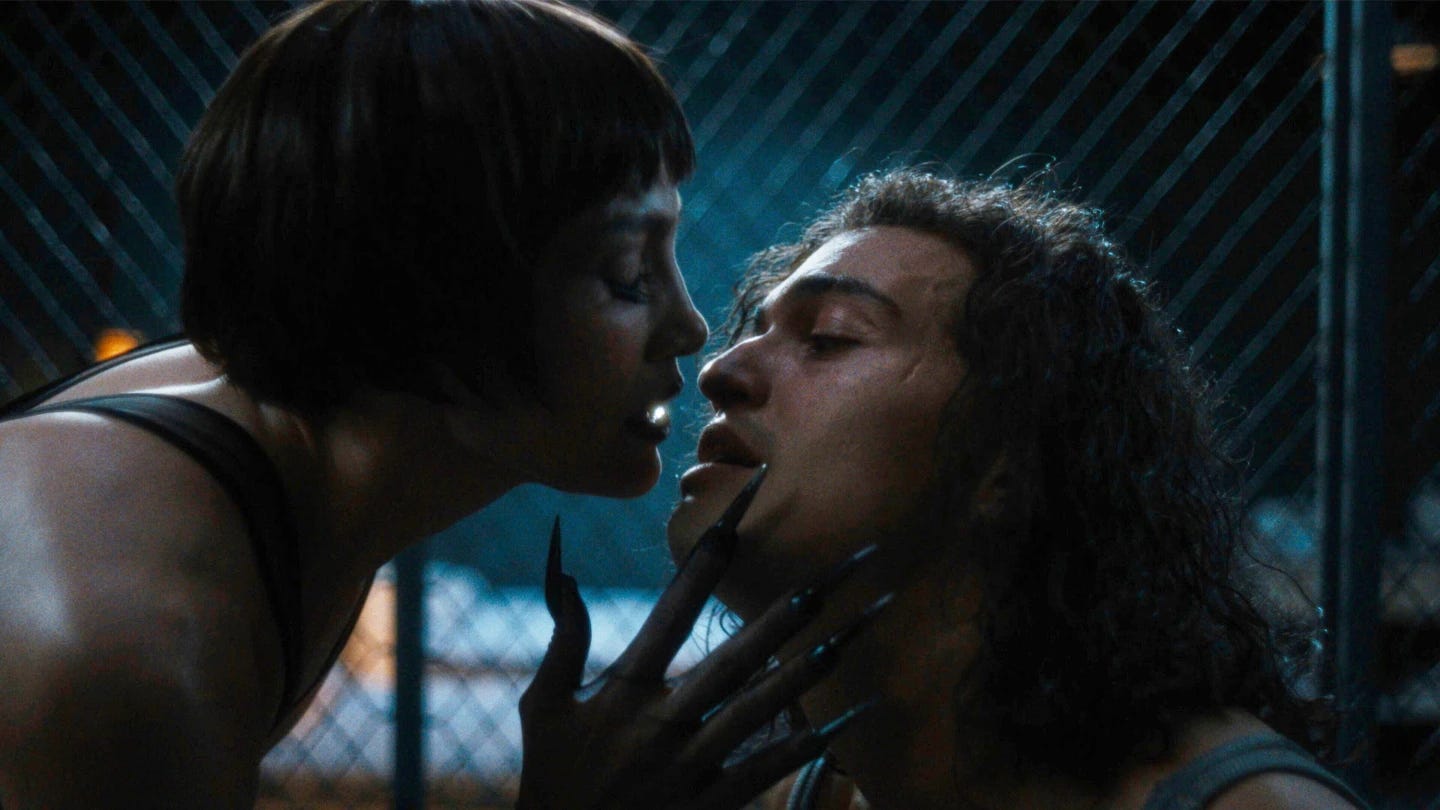
I would put Bill Condon’s new film into the second category, particularly because the changes made it more risky, and again, I think the pay-off is worth it, and the movie as a whole is pretty good. A significant part of that is due to Tonatiuh, who is just excellent in the lead role of Luis Molina, an Argentine window dresser and classic film fanatic who is imprisoned for public lewdness (another change from the source material, where Molina is imprisoned for “corrupting a minor”) and who (SPOILERS) gets a chance at parole in exchange for informing on his leftist activist cellmate, Valentin. In the later role, Diego Luna is also just *fucking* excellent and the two actors have what these parts most require: electric chemistry, evident from the first conversation, especially as conversation is the bulk of what happens. In the completely thankless role of the prison warden who starcrosses the two lovers, Bruno Bichir is note perfect, a diabolical monster hiding behind a chummy “I’m just a bureaucrat!” mask who reminds us that for many people in the twentieth century, being “tolerant” of homosexuals meant not killing them too often. In an even more thankless role, Broadway star Josefina Scaglione shows up for two beautiful and luminous minutes as Marta, Valentin’s girlfriend and the harmony on “I Do Miracles”, one of the show’s best songs. Of my four favorite, it is the only one left in, though with a hefty cut to the section sung by Ingrid Luna, the fantasy movie actress idolized by Molina, played by Jennifer Lopez.
Oh, right, J-Lo is in this film.
She’s… fine. I mean, no, let’s not be snobs: she’s better than good even, I mean, wow that woman can dance there is no denying that, and her vocals hold their own compared with everyone but Scaglione (Diego Luna has a nice, folky sound going for him but it’s obvious he wouldn’t have been able to sing Valentin’s role if any of Valentin’s songs had made the cut). Sadly Lopez is still a fairly wooden actress, something which serves the role most of the time since Ingrid Luna is a human portmanteau of Rita Hayworth and Jane Russell, who between them only had three expressions (icy, sexy, sexy-ice), but oddly Lopez falls flat as Ingrid’s alter ego, The Spider Woman, because she’s obviously going for scary but lands somewhere on Aisle 5 of a Spirit store.
In addition to the performances the film is beautifully shot, cinematically literate in a way that will please folks who adore classic Hollywood musicals. The script is also sharp, able to simultaneously deconstruct those very same Hollywood musicals while also giving us characters we can connect with, conflicts that feel extremely relevant to the moment, and lots of ideas to chew on without ever becoming didactic. As a lover of film and art, and an advocate for all kinds of queer representation that’s also good art, there’s a lot to love and I very much think you should see it in theatres, if only to remind The Industry (rhymes with “The Balrog”) that there is a cinema audience for films which aren’t Marvel or horror stories. As a writer and adaptor myself, I also enjoyed and agreed with more of the choices made than not, though I’ll never forgive Bill Condon for cutting “Anything For Him”. If I have any real hesitations with the film, it’s as a gay man, and those, well, those are my issues to wrestle with.
So let’s do it.
In many ways, the character of Molina has always been a challenging one for many queer people of a variety of identities, and within the queer literary movement. While undeniably an exquisitely crafted personality of depth and an important literary and cinematic figure in the humanization of “degenerates” homosexual, transgender, and otherwise, Molina’s flamboyant personality and cranked up femineity can be challenging in how much it seems to support (more like lean in with extreme prejudice) stereotypes of gay men. Many critics (not I personally) would probably go so far as to call it “problematic”, were it not that Manuel Puig, the author who gives us Molina in the first place, was a homosexual himself and thus is arguably “speaking his truth.” To put it bluntly, if Puig had been a straight man, KISS OF THE SPIDER WOMAN would almost certainly be considered offensive by many gay men, for its portrayal of gay men, as opposed to just being considered offensive (by mainstream society) for its portrayal of gay men as human beings who aren’t pathologically ill. That assertion (we’re not sick, we’re just homosexuals) is the heart of the novel, where the fictional narrative is frequently and intentionally interrupted, footnoted, and framed with the critique of popular psychoanalytical “facts” of the time claiming male homosexuality was a mental health issue, if not a full on corruption.
I personally think that Puig intentionally gives us one of literature’s swishiest gay men because one of the points he was trying to make is that it doesn’t matter if a man checks every box on heteronormative society’s checklist of what defines “a faggot”, he’s still a man, and more importantly a human, and deserves our respect and compassion and not imprisonment, be it in a jail or an asylum. What complicates this reading though is that Molina themselves- in the novel, stage play, and original Broadway musical- flips back and forth between presenting and verbally identifying as a male homosexual… but also as a woman. Not a drag queen, mind you, but A WOMAN. And quite specifically: a heterosexual woman aka someone who gets “the guy” at the end.
It’s probably worth noting that, according to critic Suzanne Levine, Puig began KISS as an experiment to see if he could write a “leading lady” who was (at least biologically speaking) a man. One should also bear(d) in mind that Puig both grew up in and wrote for an era when gay men frequently used the trappings of femininity, and specifically the glamorous femineity of the early mid-twentieth century (when qualities like boldness, wit, and original style were defining characteristics of leading ladies in both books and movies) as a way to make themselves more socially desirable, if not necessarily acceptable. Though it would be a stretch to say that gay men of the mid-twentieth century were any more generally respected than women were, rather like bold and witty women of the era there was usually a place for them at your party if not… you know… in your government. It’s been asserted by many a social anthropologist (and I tend to agree) that gay men, as an social identity, adopted many of their “feminine” attributes not because they necessarily wanted to, and certainly not because being a male homosexual makes you more “feminine” (most male homosexuals, especially if we think globally and historically beyond 20th century American ideas around what being “gay” looks, sounds, and acts like, do not exhibit any more or less traditionally “feminine” qualities than heterosexual men do), but because being more “feminine” makes male homosexuals less threatening to other (heterosexual) men.
And women. Though that’s probably a post for another time. Except, well… suffice it to say there’s a reason why in the few mainstream media representations we DO get of openly homosexual men before, say, the 70s, they are almost always relegated to a kind of handmaiden role in service to a leading lady. Something KISS OF THE SPIDER WOMAN the stage musical nods to in a number called “Russian Movie” that is cut from the new cinematic version. In that song, one of several where Molina entertains Valentin by acting out the various movies he loves, Molina steps in to play the (female) maid to a Russian princess played by Aurora, the equivalent of Ingrid in the stage musical (vs. the movie version, where “Aurora” is a character played by Ingrid). The new film replaces the “Russian Movie” sequence with Molina stepping into play devoted gay man assistant in the movie-within-the-movie subplot that runs the duration of the film’s narrative instead of just being an Act Two opener. This thread culminates in said alter-ego (Kendall Nesbitt) kissing the titular Spider Woman because, in said film’s storyline, said Spider Woman must periodically take the life of the beloved partner of a town daughter, in order for the nearby hometown of said town daughter to be protected from evil. Aurora, who is played by Ingrid (who also plays the Spider Woman) is this year’s lucky winner daughter but somehow sacrificing her beloved… gay male assistant Kendall… suffices to fulfill that obligation, thus sparing the life of Armando (also played by Diego Luna), the man who Aurora… actually (or at least, romantically) loves.
“Because,” Molina tells Valntin, “Aurora loves Kendall… just in a different way.”
If that sounds a little bit like a “feed the cow the silky hair from the corn husk” twist to you, that’s because it is and Molina knows it (and if you caught that reference, congratulations).
“I never said this movie was Citizen Kane,” they sheepishly admit to Valentin, who does not know that in Molina’s mind, Armando is him in a tuxedo.
By the way, if you’re confused, that’s understandable. SPIDER WOMAN, in every incarnation, plays fast and loose with just where “reality” ends and “illusion” begins (or is it the other way around?), double casting roles in a way that allows them to comment on one another, sometimes consciously to the characters, and sometimes only to the audience. Additionally, Molina is never a reliable narrator- even when they are supposedly telling the plot of a film they love.
“You’re making this up as you go,” Valentin confronts his storyteller, and Molina denies it, but in an extremely unconvincing way.
Unlike the new film, where it happens right before Molina goes on parole, the last moment of the stage musical is Molina and the Spider Woman kissing and it happens (BIG SPOILERS) after Molina is shot and killed by the Warden in a final ditch attempt to get Valentin to spill revolutionary secrets (he does not, and in the book is tortured to death, while in the stage musical, his fate is left unknown). What follows this brutal murder (in the new movie, it’s a comrade on comrade execution to save the revolution) is a finale number where Molina’s Mother (almost completely cut from the new version), appears dressed as an usher from a Hollywood Golden Era cinema and guides all the other characters we’ve met- including Marta and Molina’s crush, Gabriel, but also the Warden, the prison guards, and other prisoners- into the audience seats of a “movie” which is played out on the stage. There, Molina appears in a pink tuxedo with a top hat, and though GAY AS FUCK looking every inch a male matinee star. Fred Astair style, he solo dances while explaining why he loves movies so much, until Valentin also appears, still in his prison rags. A gunshot rings out, and Molina falls wounded. Dying in Valentine’s arms he sings the closing lines from “Russian Movie” only this time they are the lines of the Russian Princess, not the maid Molina stood in for earlier. While the audience on the stage watches, Valentine sings the show’s final line, “His name was Molina!” to the same notes that Molina, at the start of the musical, sang “Her name is Aurora!”. Finally, the Spider Woman, who has been sitting in the back row of the “movie theatre” the whole time, triumphantly joins Molina and they smooch to wild and ecstatic applause from the “audience” as “the screen” goes black. After two hours of discussions (and songs- again, most of which were cut from the new film) about just what constitutes “a man”, it is pretty clear the stage show intends the moment not just as Molina’s death, but as validation of manhood, and not just any manhood: Leading Manhood, proclaimed first by Valentin, and then sealed with a kiss by The One True Leading Lady in all of our lives: La Muerte.
Condon (thank God) keeps the number (“Only in the Movies”) but changes it in almost every other conceivable way to provide an ending that supports the decision to have Molina be a transwoman who is prohibited from transitioning, instead of a gay male homosexual who just really likes lady stuff because he is, as Molina self-brands in EVERY version of the story, “a sissy.” Gone is the audience from which Molina has spent her whole life seeking approval (including Molina’s Mother, who still appears as an usher but now leads her child into the theatre and then vanishes), gone is the tuxedo and replaced with a high fashion ballgown similar to the kind Molina the window dresser would have dressed mannequins in, and gone are the pronouns which Molina has spent her life rebelling against. The only man in the room is Valentin (now in a tuxedo of his own) and when the gunshots cut the dance scene short it is Molina who makes her way to the Spider Woman, not the other way around. Standing at the top of a staircase, arms open wide, Spook-Lo (err… the Spider Woman) reads more as a Velma Kelly whose been waiting for her Roxie than a feminine embodiment of the sweet mercy of Death and gone, most important of all, is the titular kiss. Condon ends his “Only In The Movies” with Molina climbing the stairs, one Queen on her way to either co-rule or, who knows, replace. And you know what? It works. It actually works.
“Yeah, but I’m not sure I want to see it now,” a gay male friend of a certain (younger than me) age said to me on the phone this morning, after I mentioned I’d seen the film last night, and shared many of the thoughts I’ve shared here. “Like, trans right are human rights and all, but I’m sort of tired of gay men being erased,” and while I don’t think that’s what’s happening in the film as a whole, I do understand the feelings.
I also understand the desire to “protect” a piece that, while always a bit challenging and controversial for queer and non-queer audiences alike, was still instrumental in helping to create gay male representation back when just how stereotypical it was or wasn’t hardly mattered so long as it was there at all. That said, I think KISS OF THE SPIDER WOMAN THE MOVIE (OF THE MUSICAL OF THE MOVIE OF THE BOOK) actually manages to be both a beautiful film unto itself about a transgender woman, and still strike a blow for ALL QUEER PEOPLE, including Queer Men, if not necessarily (or exclusively) Male Homosexuals (aka Gay Men) and as a Gay Man… I can get behind that. And endorse it. And feel like even if the representation I feel closest to is no longer central, it also hasn’t been erased.
As staged at The Broadhurst Theatre in 1994 (which is when I saw the show starring the late great Chita Rivera) there is nothing in the Broadway musical that leads us to believe that Valentin would engage in homosexual sex for any other purpose than manipulating Molina (and even less so in the novel, or the 1985 film where [SPOILERS] in what is heavily implied to be a verge of death dream, Valentin is rescued from torture by Marta). Nor is there anything in the show that leads us to believe he returns Molina’s romantic interest. What there is, however, is overwhelming evidence that this young and passionate man comes to respect his gay/trans/queer cellmate and understand that they are both part of the same struggle for freedom and self-fulfillment denied them by society for different reasons, but to the same end. The Valentin of the musical rides into curtain call not as Molina’s lover, but as Molina’s biggest fan. Leading the applause for the final big kiss, Valentin does for Molina what Molina could not do for himself: admire him. Celebrate him. Be inspired by him the same way Molina was inspired by Aurora. “His name was Molina!” is sung the same way online activists now post “Say their name!” on social media. It is tribute, but also a flag being waved, a call to arms. And in the 90s this would have been a really important thing for gay and straight male audiences alike, not because gay men needed straight men to validate their manhood, but because we needed them as allies, which often entailed first getting them to see us as fellow men.
I don’t get the impression that Condon isn’t aware of all this, but he’s making a movie for right now and so he’s changed the story, smartly ending his film in a silent pan up and away from the prison yard, so that the final moment we see is not musical theater or Hollywood spectacle, but the heartbreaking beauty of men set free from torture while, on just the other side of the wall, the streets are filled with the people of Argentina reclaiming their country. That said, he still gives Valentin the last line, albeit, spoken: “We made it, my love,” the revolutionary whispers to the red scarf that Molina gave him when they parted for the last time. When a moment later he kisses the scarf, the statement feels almost as explicit as changing “His name was Molina” to “Her name was Molina.” The Valentin of Condon’s film may not be a homosexual, let alone “gay”, but he certainly also isn’t a straight man who just needed his revolution to win and was willing to fuck a guy for the cause. To Luna’s credit, he slow burns his peformance that makes it clear his Valentin isn’t just warming up to Molina’s humanity, but falling in love with Molina herself.
“In Hollywood, the homosexual always dies,” Molina tells Valentin, in a line I’m most certainly paraphrasing, and she is not wrong (though thankfully, these days, she’s also not entirely right, either). In this one, specifically, the Trans Woman ™ dies (which is the new cliché), but the Queer Man ™ lives, and there’s something very beautiful and important about that. It’s a reminder that all the initials of the ever-expanding abbreviation (ironic, isn’t it?) are in this together, not because we necessarily all get along all the time, and certainly not because our identities are interchangeable (for the record: Gay Men are Men, no matter how “effeminate” we may or may not be, and Men can be Manly in many different ways), but because we’re all up against a world that tells us who we are instead of letting us live the way we are.
Let alone the way we dream we could be.
*************************************************************************************************************
Hello!
Thank you for reading!
So, in a moment of just, fuck it, I’ll give it a try, I am finally doing that thing people keep saying I should do and giving you the chance to support my writing.
If you would like to help keep this middle-aged single writer turned food equity coordinator/usher/online content creator/social media manager in the black, I accept Zelle (it’s my phone number), PayPal (@stuartbousel), or CashAp ($Bousel) and I leave it up to you to decide what to give.
You can also get a paid subscription to my Substack. I offer multiple options- two year, one year, and month to month subscriptions. All of them help with my month to month lease.
Obviously, I’m not going to put anything behind a paywall and I’m honored you read anything I write at all. I’m going to try to write something here every Sunday/Monday, around this time, and if you have thoughts or feelings you’d like to share with me to write about I’d love that.
And in case this isn’t clear: this site is not intended to be a news source. And though it may veer into memoire I admit that if it makes for a better story, I may play a little fast and loose with “the facts” so take everything with a grain of salt. Reviews and culture discussions included, any views I present here which are not cited otherwise, are my own, and I do not speak on behalf of any organization or person but myself.
Be well. Reach out. You are a light.
Stuart
Loved the original movie, especially Raoul Julia who sadly died of AIDs. I also saw him on stage in a Noel Coward play in NY; riveting performances in both.