
May 16, 2026
To Helen And Back Again

I know what you’re all wondering:
Does he have an opinion on Christopher Nolan’s forthcoming film of THE ODYSSEY?
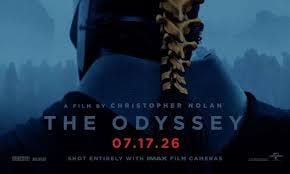
OH BOY DO I EVER but... I’m also a “wait till you see the movie” guy before passing ultimate judgement (I mean, I even went and saw WICKED before I wrote about it in any meaningful way) so what I really have at this point is hopes and fears.
Fears:
Honestly, just the usual. That they’ll either end up cutting a lot of the magic and mythical stuff out in an attempt to turn it into some sort of American action flick like Wolfgang Petersen’s 2004 meathead masterpiece TROY, or that it won’t be able to pull off the magic and mythical elements either technically or tonally and it will end up camp, like Andrei Konchalovsky’s 1997 miniseries.
The preview makes it clear that some of the monsters at least have made it in (and won’t just be cavedudes in masks like 2011’s IMMORTALS), and Nolan’s career has certainly made it clear that he’s both down for fantasy elements on film and good with large-cast ensemble stories, but most cinematic treatments of Greek mythology have missed the spirit of the myths even when they’ve gotten the aesthetics correct, and this is why I think, for many of us who are mythology nerds, the original 1981 CLASH OF THE TITANS is still sort of the gold standard because no matter how badly some of the effects have aged (and honestly, they’ve aged better than most CGI has) the movie just feels right, somehow managing to ground the humanity of the story without losing the sense of wonder inherent to the material.
Of course, THE ODYSSEY is headier than the story of Perseus, which in many regards is more of a fairy tale than a myth, but part of what I love about CLASH is that for all its old school Hollywood romance trappings there are still relatable characters and moments of profound musing on the role of humankind in a cosmos bigger than all of us. The best mythology is fundamentally about how we navigate a world we can only partially understand but defines us and offers us meaning if we choose to find it, and most cinematic treatments of ancient myths tend to flatten all of that out because they are made by people who are either too critical or too reverent even though the best tellers of old tales usually come from places of curiosity and compassion.
Mythology, unlike history or religion, asks WHY? of the human condition and the world at large, but rarely provides The Answer even if the story comes with An Answer.
Put a pin in that.
Hopes:
I think Matt Damon and Anne Hathaway are PERFECT CASTING. I personally would not have thought of them in the roles (for me, a child of Masterpiece Theatre, I’m always going to want my swords and sandals pics to be a pu pu platter of Brits) but at this moment in history, and with global culture (in regards to who will watch this movie) being where it is, I think a pair of Gen X/Elder Millennial Americans are kind of perfect because, as a Gen X American myself, I thoroughly believe (nay, I CRAVE) Will Hunting and Mia Thermopolis as two reluctant 45-50-something participants in a big story that is someone else’s mess they’ve been forced to deal with when all they wanted was this tiny little kingdom they call home after a lifetime of surviving “one in a lifetime” events.
The thing I think so many adaptations of this material get wrong, is that Odysseus is NOT some super buff dude with hero stamped on his forehead, nor is he some glamorous aristocrat, nor is he a profoundly good and flawless person who never makes mistakes. He is smarter than the average mortal, a bit of a charming rake while still also a gentleman (especially by the standards of the time), and while he usually tries to do the right thing and play by the divine laws he’s not a pillar of nobility or piety, he’s… ultimately… more or less… sort of just… some guy. WHICH IS THE POINT, BY THE WAY. He’s got mortal parents (both of them), a small but self-sufficient kingdom that’s basically a bigger than average ranch next to a truck stop village, and a bad habit of being in the wrong place at the wrong time. His “I’m just a guy-ness” is why he’s so relatable; he’s equally cursed and blessed, as most of us are, including Penelope, who is neither a damsel in distress nor a warrior woman nor a sorceress, but just an approachably pretty, smarter than average cottage core queen who married a level 11 Bard and has learned to make do with him on walkabouts.
In other words… exactly the roles Matt Damon and Anne Hathaway, both intelligent and seasoned actors who have proven they can carry even bad movies, should be playing at this point in their careers.
The rest of the cast is a range of hopeful for me. Robert Pattinson is not one of my favorite actors but I think he’s well cast as a character who should sort of drip smarm the way he does. Charlize Theron is 50 and since we don’t get a lot of older women playing nymphs I like it because Calypso has to be an adult in a world of old men and children (aka a world that’s been devastated by a massive war), it’s key to her deep loneliness. Samantha Morton, John Leguizamo, Himesh Patel and Zendaya are all actors whose work I enjoy and I think with each of them we’re getting a chance to add a little more texture to roles that are often considered secondary but in reality are the glue that holds the story together. Zendaya in particular I think is a strong choice because she’s not even thirty but has the gravitas of a woman twice her age and Athena is another figure I think is frequently “gotten wrong”, with Susan Fleetwood’s brief but elegant and quietly powerful turn in the original CLASH OF THE TITANS being the only screen Athena I like. A younger goddess, Athena is BOTH woman warrior and dutiful daughter, both gentle teacher and eager student; you need someone in the role who can flip between and Zendaya has repeatedly shown herself to be a versatile and smart actor.
“Sure sure sure sure sure…” they ask, “but what about… you know…” and give me the “I don’t want to say it but I really want you to talk about it” look.
“Mia Goth as Melantho?” I ask, shrugging. “I mean, people seem to like her. I don’t think she’s gonna bring much but she’s a minor character that’s been made important by contemporary readers and since we all know Mia Goth is good at screaming I can see-“
“Not Mia. You know… Lupita.”
“Sure. She’s actually not an actress I have strong feelings about. I respect her work but scanning through her filmography I realize I’ve only seen like… two of her films and one was STAR WARS, which I’m sure is not… indicative. I shall remain open minded.”
“Yeah, but, I mean… c’mon… HER… as Helen of Troy?”
Oh. Le Sigh.
Okay, so…
1. I LOVE the idea of the same actress playing Helen of Troy, also playing Clytemnestra. I mean, anyone who knows me and knows my work, knows I love meta-casting that comments on the characters, and one actor playing multiple roles in a way that is obvious but narratively sound is the most delicious kind of commenting a thoughtful writer or director can do, if it’s done well. My adaptation of the Trojan War/Odyssey/Aeneid (THE ALL OR NOTHING PLAYS) literally hinges on EVERY ACTOR playing three characters: one mortal, one divine, and one the personified archetype of the other two so… THIS IS MY JAM. Dopplepairing Clytemnestra/Helen is potentially so brilliant (since they’re shadow versions of one another AND sisters) that I am not only 100% willing to forgive the part where Clytemnestra isn’t in THE ODYSSEY, but also anticipating this choice the most, as it’s the most intriguing “idea” I’ve heard about this film yet, hats off to Nolan. And also HOW DARE YOU THINK OF THIS BEFORE ME.
2. All that aside, I consider Helen of Troy an “uncastable” role. So much so that, in my plays, she is played by a literal head on a literal stick that is carried around by the other characters and talked at but never responds (hence, not even a puppet, just a head on a stick). For me, this was not only a great way to have lots of fun and occasionally quite sinister sight gags, but it also relieved directors of my show from having to wade into the quagmire that is casting whenever you are supposed to cast something like “the most beautiful woman in the world.” Because here’s the thing: she doesn’t exist and never has and THAT’S THE POINT. Helen isn’t really human, both factually speaking (her father is Zeus, so she’s a demi-god) and allegorically speaking: she’s a plot device. She’s Hitchcock time bomb under the table, interesting because of the people around her that might get killed, not because bombs themselves are interesting. So any attempt to humanize her usually falls short of its goal, whether it’s a writer like Euripides attempting to do it or an actress like Irene Papas in the 1971 adaptation of his play, THE TROJAN WOMEN. And to be clear, Euripides’ character of Helen is complex and fascinating and Papas’ performance is unforgettable but both only work in the context of that specific play because they play AGAINST the very idea of a “most beautiful woman in the world”. Most cinematic treatments of Helen just try to cast the woman who checks the most boxes of what the director thinks is “conventionally beautiful” (emphasis on “conventional”) and that is why, with all due respect to the formidable talents of Rossana Podesta, Sienna Guillory, and Diane Kruger (to name just a few) we usually get a blonde cover model in the part, and usually the casting card was a Looks: 10, Act: 3 situation.
Shit. Now I want a Greek Mythology version of A CHORUS LINE where everyone’s auditioning for Helen. Including all the men.
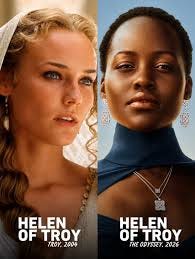
Anyway the point is, NOBODY cast in the role of Helen of Troy has ever pleased everybody (except maybe Papas, specifically in that role the way THAT FILM re-conceived it) and NOBODY cast in that role EVER SHALL and that’s before we get into the obvious racism apparent in how loud the “controversy” over Lupita Nyong’o is compared to, say, Kruger, who was also heavily critiqued on her appearance (and that’s really sad considering she’s a damn fine actor) but nobody at least questioned if she “could” play the role. As in, whether or not she was “allowed” to play Helen of Troy. Clearly nobody gatekeeping the role of Helen is doing it based on concerns around the craft of acting. Though can you imagine? Like, he’d still be wrong but I’d sort of love a world where Elon Musk, the world’s Least Worthy Meritocrat, was like, “But Lupita hasn’t studied the Method!” Like I wish THAT was what we were talking about here but we all know it’s not.
While we’re fantasizing together, I actually think Musk cast as Helen of Troy is what the world really needs. That’s the Helen of Troy we deserve. Certainly, it would be a comment. Maybe not quite as brilliant as Head On A Stick Helen (thank you, thank you) but you know… close.
And no. No, we won’t be getting into any kind of discussion of “historical accuracy.” For one thing, that’s Classics Majors stuff and, as my many classics major friends in college will tell you, I am a lit major with an emphasis on mythology and folkore, NOT a classics major. I just hung around with a lot o them, sort of like how a drummer hangs out with musicians. And while I could explain to you, at length, why mythology never needs to play by the rules of history or religion, this has gone on long enough so I will simply say that I adhere to the school of belief that mythology, no matter where it originated, belongs to EVERYBODY. So even if THE ODYSSEY was set in a relatively homogeneous place like Iceland instead of in the middle of the sea that is in the middle of three continents and has thus been ethnically diverse for thousands of years, I would still be like, “Cast whoever you want.”
Mythology, by its very nature, evolves. Not our understanding of it, like history, but how it functions in our lives, socially and individually. Unlike the rules of religion, which are set and usually not supposed to be questioned even if they can be pushed, the details of myths don’t stay the same and the myths themselves don’t stay put- they travel. From storyteller to storyteller, place to place, era to era. The relevancy of any given myth lies in its flexibility and though myths may be incorporated into religion and history (and psychology and aesthetics and theatre and a whole lot of other mediums) they can never be contained by those things. Myths become what each storyteller needs them to be and the best storytellers tend to be the ones who read the room and adjust things to who is listening and the world THEY live in. Not the world the myths come to us from.
“Myths are important for one reason: there’s a version of everything where nobody dies.” The character of EROS says, at the top of Act Two in SEE ALSO ALL, my play about the Trojan War and the first half of THE ALL OR NOTHING PLAYS.
And he’s right.
There is a version of Antigone’s story where she lives, and the same for Iphigenia. There is disagreement over the origin story of Medusa, how many children of Niobe perished in the massacre at Sipylus, how many seeds Persephone ate in the underworld. Was Hephaestus the son of Zeus and Hera or did she conceive him on her own? Is Apollo the god of the son or Helios? Depends on who you ask and what century you’re asking them in. Greek mythology changed and re-wrote itself numerous times in the region we now call Greece over a large span of time we call ancient, but the fact is the versions most of us know largely comes to us through non-Greek sources and bear the stamps of those cultures and those eras. Greek mythology also probably wouldn’t even be such a thing if the English poets of the 16th century hadn’t loved it so much they simply had to re-write it, or the German psychologists of the 19th century hadn’t found it so useful they codified it into science.
I mean, there is even a version of the story where Helen never even went to Troy, she was in Egypt the whole war and everyone fought over a cloud shaped like Helen (stupid idea, head on stick much better).
All of which is why it’s perfectly fine for Americans to play ancient Greek royalty, or a Colombian actor to play a Mediterranean shepherd, or a human to play a goddess, or a Black woman to play Helen of Troy.
If the Storyteller makes it work, it works. Because that’s who mythology belongs to. Not you. Not me. Not Christopher Nolan. Certainly not Elon Musk. All any of us can do is take a turn putting our spin on it.
May the best Storyteller win.
********************************************************************
Hello!
Thank you for reading!
So, in a moment of just, fuck it, I’ll give it a try, I am finally doing that thing people keep saying I should do and giving you the chance to support my writing.
If you would like to help keep this middle-aged single writer turned food equity coordinator/usher/online content creator/social media manager/theatre maker, I accept Zelle (it’s my phone number), PayPal (@stuartbousel), or CashAp ($Bousel) and I leave it up to you to decide what to give.
You can also get a paid subscription to my Substack. I offer multiple options- two year, one year, and month to month subscriptions. All of them help with my rent.
Obviously, I’m not going to put anything behind a paywall and I’m honored you read anything I write at all. I’m going to try to write something here every Sunday/Monday, around this time, and if you have thoughts or feelings you’d like to share with me to write about I’d love that.
And in case this isn’t clear: this site is not intended to be a news source. And though it may veer into memoire I admit that if it makes for a better story, I may play a little fast and loose with “the facts” so take everything with a grain of salt. Reviews and culture discussions included, any views I present here which are not cited otherwise, are my own, and I do not speak on behalf of any organization or person but myself.
Be well. Reach out. You are a light.
Stuart