
March 22, 2026
And Angel Sing Thee To Thy Rest

I haven’t been able to sleep all weekend and I know it’s because It’s Finally Time.
It’s Finally Time to write about BUFFY THE VAMPIRE SLAYER.
Of course, I’ve been trying to write about BTVS for most of my adult life. I had actually wanted to scribe about BTVS for my thesis at Reed, but I was dissuaded from doing so for both the very pragmatic reason that there simply weren’t enough secondary sources in existence at the time (I graduated in 2000 and “Fighting The Forces”, the first academic study of BTVS wouldn’t be published until 2002), and the more abstract but equitably astute observation by my academic advisor that I should write a creative thesis, probably a play, and probably about classical subject material, as that would actually be the culmination of my time at Reed. The resulting work, VINCENT OF GILGAMESH, is the aesthetic cornerstone of my playwrighting career so congratulations, Natalia, you were right (and thank you Pancho, Kathleen, and Wally for agreeing to co-advise me on a cross-discipline project that defied easy categorization as an English thesis). In retrospect the real reason not to write about BTVS was that in 2000 we were only in Season Four. The story wasn’t done yet, and I had no idea what was to come.
Of course, the story would go on for many years after I finished my thesis- decades if you count the comic books, which I do not. To be honest, I actually don’t count anything past Season 5, which ended with the 100th episode and the deification of the titular heroine- perhaps the most earned ascension since Frodo sailed into the west. I watched the final two television seasons because I felt obligated to do so but aside from a handful of decent episodes (yes, yes, the musical episode) there wasn’t much in the way of compelling writing and driving dramatic action during Season 6. By the time the seventh season aired the show was essentially eating itself, becoming its own cliché while living up to every cautionary tale about what happens when a story runs out of steam long before the creators stop needing it to make them money.
Though for years I, along with many fans, warbled between desiring and dreading a reboot or sequel (ANGEL, the spin off show, was never even close to a substitute), the nearly perfect and totally epic storytelling arc of the first 100 episodes of BUFFY eventually became enough of a gold standard for long form fantasy television that I became contented with what we had. Now, with the death of Nicholas Brendon, coming on the heels of the news that the much anticipated BTVS reboot will not be happening, BUFFY THE VAMPIRE SLAYER seems pretty much done for good, even if Sarah Michelle Gellar seems to be experiencing a well-deserved career revival, and one still hopes Charisma Carpenter will too (truly one of television’s funniest women). Though his character (Xander Harris) was hotly divisive and Brendon himself was a mixed bag of addiction, spousal abuse, and petty crime, a BTVS without him seems impossible to imagine, and is why his death, while no less tragic than Michelle Trachtenberg’s untimely loss in 2025, hits most BTVS fans harder. Additionally it sounds the death toll of the BTVS IP in a way nothing previously had. Love or hate Xander (or, God forbid, have a balanced perspective on him), Sunnydale just wouldn’t be the same without him. And by same I mean it wouldn’t be as good.
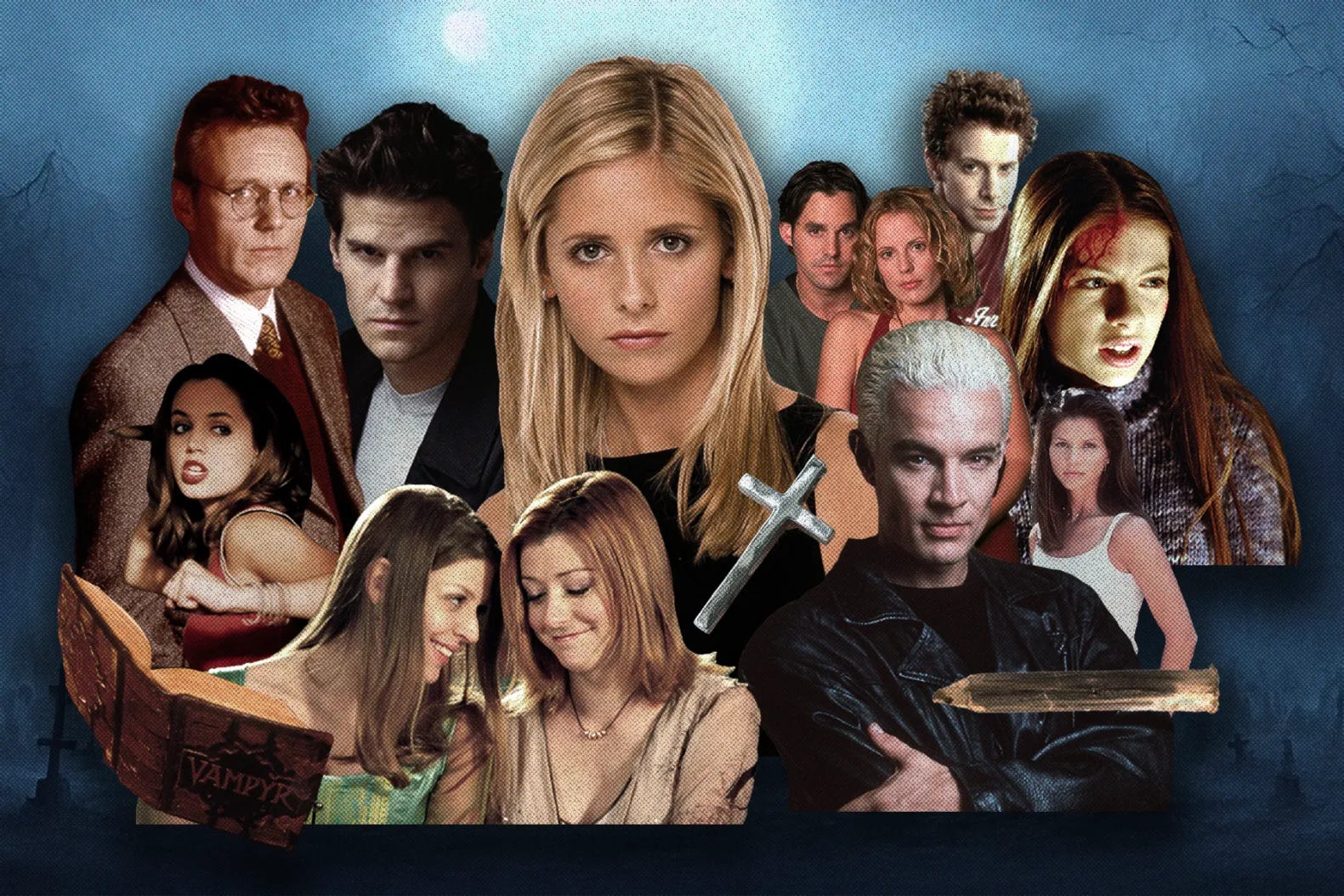
For those who are only nominally familiar with BTVS, Xander Harris was the show’s entry point character, the person most audience members were expected to initially identify with because he was an “every-teenager”: open hearted, earnest, generous, and loyal- but also shallow, vain, attention seeking, horny and… frequently kind of mean. Because BTVS was a show about a young woman, convention made the most important male character both her side-kick and a secondary love-interest, though he never stood a chance against Angel (David Boreanaz), the vampire with a soul who had been engineered by the writers (and God) to be the perfect romantic foil for a girl who killed vampires, but was also into brooding, tortured emo dudes (and from 1997 to 2001, who wasn’t?). In his attempt to court Buffy none-the-less, Xander did all the things popular culture then expected young men in such situations to do, and popular culture NOW judges very harshly, even though Xander never really does anything worse than Eponine in LES MISERABLES, or numerous other eighteenth century maidens in unrequited love. He also never violently assaults Buffy, like Angel does, or sexually assaults her like her second secondary love interest, Vampire With A Soul But Blonde, aka Spike (James Marsters). Still, until he eventually found love of his own, first with Cordelia (Charisma Carpenter), the high school queen bee and possibly the world’s most self-possessed human being, and then with former demon turned avaricious saleswoman Anya (Emma Caulfield), Xander’s plotlines alternated between holding the main seat in Buffy’s friendzone and providing her principal connection to “normal” life and “normal” people.
Not that normal people abounded on the show. Aside from Joyce, Buffy’s earnest but often distracted mother played by the magnificent and wildly underappreciated Kristine Sutherland, Xander is actually one of the only characters who remained consistently ordinary. Though Dawn (Michelle Trachtenberg) would begin as a magic item given human form and sentience (a brilliant way for the writers to take the cliché of adding a sibling character to a show late in its run, and use that as an actual plot point) she would ultimately end up an ordinary young woman, while everyone else Buffy met over the next five years was either magical to begin with- like the teenage witches abused Amy (Elizabeth Anne Allen) and lesbian Tara (Amber Benson), or the technopagan computer teacher Jenny Calendar (Robia LaMorte)- or would become so: stoic, guitar playing werewolf slacker Oz (Seth Green) for instance, or most notably, sweet and smart Willow (Alyson Hannigan), whose transformation from nerd to Level 20 sorceress is the only character arc that comes close to rivaling Buffy’s.
Of course, there are multitudes of minor muggles (some even played by Amy Adams and Pedro Pascal) but even some of these, notably the short and shy Jonathan (Danny Strong), end up learning enough magic to cause havoc for an episode or two (and in his case, morph into a main character in his own right). Even Buffy’s almost healthy, almost normal relationship with college boy Riley (Marc Blucas) ultimately goes south when he first turns out to be part of a secret paramilitary group fighting the same supernatural forces she is, and then gets into hiring vampires to suck his blood in cemetery bordellos.
“First vampires, and now witches,” Xander famously laments in the third episode of the series, “No wonder you can still afford a home in Sunnydale,” thus cinching his role as being the character most likely to say what most of the audience was thinking, and drawing the line the series would walk, pretty flawlessly, for Five Glorious Seasons.
As my friend Nicole once said, “ANGEL is a ridiculous show where the characters take everything seriously while BUFFY is a serious show where the characters take nothing seriously.” An entirely accurate observation, this was probably the show’s greatest asset and it became more essential as the scope of Buffy’s destiny to combat evil expanded with each season. From the very localized world of high school in Season One, to the bigger one of adult relationships in Season Two, then civic tension in Season Three that evolved into national conflict in Season Four, before culminating in cosmic and spiritual battles in Season Five, as more and more was revealed BTVS’s sense of humor about its own improbability is what kept it all grounded and emotionally true. As Buffy’s own comprehension of the vast interconnectedness of everything increased, so did her comprehension of the layers and nuances that often arrive with such knowledge, till the humor was essentially weaponized so that neither the character nor the audience collapsed in overwhelming understanding of just how hard it is to live a world where we are inspired by longing, blinded by passion, and surrounded by danger.
The profound cost of the invisible work of protecting others was regularly recognized and celebrated, principally in the relationship between librarian/guide Giles (Anthony Stewart Head) and Buffy as they slowly but surely came to realize both the importance and impossibility of mentorship, how it is both necessary for survival but ultimately as limited as any other relationship. Constantly torn between the isolating nature of a duty to help and protect others, and the basic human desire for connection and companionship, the show explored the burden of being special, being unique, being loved- and somehow still being alone. In what is probably, still, one of the best, if not single best dramatization of what it feels like to say “I’m queer” (whatever your variety of queer may be) to the people who matter the most to you, Buffy quite infamously “comes out” to her mother at the end of Season Two with such authenticity and sensitivity that it still occupies an almost unequivocal space in Queer Television and Queer Literature in general. It’s the “No, it doesn’t stop; it never stops” line, said in retaliation to Joyce’s command that Buffy stop being The Slayer, that gets a lot of us because being queer never stops and it never will; what does happen is that one day, if you do the work (or you just get lucky), YOU stop wanting it to stop. And you stop apologizing to the marksman for being the target.
Refusing to lay down and die, to be a complicit part of the systems that destroy us, was another major theme of BTVS. Perhaps best exemplified in the Season Three finale where the teenagers of Sunnydale turn on their various predators in a fellowship of jocks, nerds, cheerleaders, music kids, preppies and stoners- and where, sadly, BTVS’s only openly gay male character, Larry (Larry Bagby), dies- the theme would repeat in Season Five with even deeper emotional resonance when Buffy faces her greatest challenge: not the goddess (Clare Kramer) she spends most the episode fighting, but her own destiny as leader, savior, and thus ultimately: a sacrifice for the greater good. She comes through it, Gethsamne style, and the 100th episode ends (and the series should have ended) on a simple tombstone that says, “She saved the world. A lot.”
You see, BUFFY THE VAMPIRE SLAYER was more than a cultural phenomena because it was more than just a show. It was not just a wildly detailed, multi-narrative soap opera with just enough inconsistencies to keep it surprising, but a collection of morality tales where the expectation of how things were supposed to be was first complicated by how things actually were and then transformed by how things could actually be when people consistently chose the light over the darkness. It was an entire mythology and almost a religion. It was a shadow Christianity for a new generation of Americans that attempted to bring Christianity back to its progressive roots, and America too.
And yes, it was a terrifying vision of the world, to be sure, one that demanded not just Buffy’s sacrifice but that of fellow slayer Kendra (Bianca Lawson), while poisoning the soul of a third slayer, Faith (Eliza Dushku). It broke Jenny and Riley and Spike, killed Larry and dozens of other teenagers, but it was also one where Jonathan’s pain could be heard, Larry’s homosexuality would not be mocked, Jenny’s betrayal could be redeemed, Angel’s sins forgiven, Tara’s loneliness assuaged, Joyce’s strength honored, Giles’ wisdom heard, Willow’s potential realized. It was a world where both the duality of Oz and the singularity of Cordelia could be harnessed for good actions when both rose to the challenges their unique gifts presented them with. Though Buffy was surrounded by enemies on all side, she was also surrounded by people she made better and who made her better. Her journey was one of coming into her own, as a human but also as the idea of what it meant to be Human in a world made for monsters. The show may have walked like a B movie and talked like a music video, but it read like a Bible if you really paid attention and it taught you things that could get you through your actual life. Mostly that all of us, even Xander, have the potential to serve something bigger than us.
There are so many good episodes of BTVS that it’s honestly hard to pick a “best” but I’ve rarely met a BTVS fan who doesn’t have a favorite- and I’ve rarely met two BTVS fans whose favorite episodes are the same. Still, if you watch enough highlight reels or talk to enough people certain episodes will consistently float to the top of the list and usually include Season 5’s “The Body” (which is just a truly solid piece of acting, directing, and writing all around), Season 4’s “Hush” (which is the closest that BTVS ever really got to making a Bonafide Horror Film TM), Season 3’s “Earshot” (which is the BTVS version of an “Afterschool Special” and thus the ultimate homage to the 90s), and Season 2’s “I Only Have Eyes For You” (a deeply unsettling but also bittersweet ghost story about forgiving the unforgivable).
My personal favorite was and will always the Season 4 finale, “Restless.”
If BTVS was a musical, “Restless” is the 11 o’clock number for the whole series. Featuring some of the show’s best editing and cinematography, as well as a stunning score by Christopher Beck, it is BTVS’ “Art House Film” episode, heavily referencing the work of cinema legends like Roberto Rossellini, Peter Greenaway, Federico Fellini, and Akira Kurosawa, not to mention virtually every major character and relationship in the history of the show- which was a lot by episode 78- in the same way the final 15 minutes of Sweeney Todd samples every song we’ve heard up till then. Written and directed by the show’s creator, Joss Whedon (weird how I’ve only mentioned him once this whole time… or is it?), and told through four intersecting dreams dreamt by the show’s four principal characters (Buffy, Xander, Giles, Willow), it is by turns hilarious, poetic, and deeply spiritual. It also lays down the ground work for Season 5, often dropping hints in throw away lines (Tara says to Buffy at a very key moment, “Be back before Dawn”) or unexplained images (Spike and Giles on a swingset; Joyce stuck inside a wall) that would only make sense a year after it first aired… which was a week after I graduated college. With a central theme of having come so far in life only to finally begin the real journey (an idea at the core of most spiritual practices, when you think about it), scene after scene shows the protagonists confronted with their fears but also deep truths about themselves and the people they love, often stemming from the limits of their identities but also allowing for the possibility of transformation against the claustrophic paradox of a world that is simply too big for the time we are given in it.
I still remember watching that episode in the living room of my parents’ home in Tucson, listening to the final lines (“You think you know. What you are… What’s to come. You haven’t even begun.”) spoken over a shot of Buffy standing in the doorway of her dark and empty childhood bedroom. I also still recall the silence that followed after I shut off the TV, then out to the back yard, where I took off my shirt and laid down on my back in the pool. Floating on the surface, looking up at the cloudless blue sky, I watched the sunset and knew acutely that I had so much of my life yet to live, and no idea what that really meant.
Sometimes I still get a taste of that feeling, usually if I wake up between 4 AM and 6 AM, and can’t get back to sleep but also can’t seem to do more than lay in bed, staring at the ceiling. Or it may also happen if I’m up past midnight, reading a book by the light of my bedside lamp, and a noise from outside makes me aware of just how quiet the darkness has become. Occasionally, a Sunday afternoon may also do the trick, particularly if I’m working at my desk or have my back to a door and suddenly I sense the fog is rolling in, or the tide is changing at the beach I rarely visit but live less than five miles away from. Rarely but always profoundly when it occurs in this manner, there will be a morning where the sky is clear, the sun is shinning, but I’m not sure where the day will take me.
It’s a kind of psychological echo, of course. The shiver of the soul when it rises from the comfort of not thinking about death only to step into the longing of mortality. It reminds me of the spring, both the ones which are left to come and that one long ago, when I was a vampire slayer.
And a vampire.
My own problem and my own solution.
An everyman living in a dangerous world I probably took too seriously, my life a timeless legend captured by a contemporary TV show that, like most gods, is probably better left in peace, than resurrected.
*************************************************************************************************************
Hello!
Thank you for reading!
So, in a moment of just, fuck it, I’ll give it a try, I am finally doing that thing people keep saying I should do and giving you the chance to support my writing.
If you would like to help keep this middle-aged single writer turned food equity coordinator/usher/online content creator/social media manager in the black, I accept Zelle (it’s my phone number), PayPal (@stuartbousel), or CashAp ($Bousel) and I leave it up to you to decide what to give.
You can also get a paid subscription to my Substack. I offer multiple options- two year, one year, and month to month subscriptions. All of them help with my month to month lease.
Obviously, I’m not going to put anything behind a paywall and I’m honored you read anything I write at all. I’m going to try to write something here every Sunday/Monday, around this time, and if you have thoughts or feelings you’d like to share with me to write about I’d love that.
And in case this isn’t clear: this site is not intended to be a news source. And though it may veer into memoire I admit that if it makes for a better story, I may play a little fast and loose with “the facts” so take everything with a grain of salt. Reviews and culture discussions included, any views I present here which are not cited otherwise, are my own, and I do not speak on behalf of any organization or person but myself.
Be well. Reach out. You are a light.
Stuart
FINALLY that alternate universe Reed thesis gets written. Bravo. Though I will still argue that the comedy stylings of Andrew in Season 7 almost justify that season’s existence.
As a sort of interesting post script to this essay, my friend Nicole who is quoted in it, but who doesn't follow me on Facebook, did read the piece and we had the following text conversation (which she graciously gave me permission to repost):
NICOLE: "Vampire With A Soul But Blonde" 🙂 A very good essay! I was surprised that Nicholas Brendon's death shook me but it did.
ME: I was talking to a film critic I know on Saturday and she said that the triad of Nick (Brendon), Michelle (Tractenberg), and James Van Der Beek all dying relatively young and within a year of each other marks a major milestone for late Gen X. The people we grew up thinking as "our age" are now old enough to die of stupid ordinary things like diabetes, heart conditions, cancer. Which means we're all too old to only die of drug overdoses and fast cars. But still too young to accept that we're all gonna die of something. Celebrity deaths bring that home in a way your one friend dying doesn't. Like, even Xander isn't gonna live through The Last Season.
NICOLE: Exactly. I also identified with Xander for a time. I rode that "everyone else is special" train for longer than I'd like to admit. Re: the quote from me, I honestly don't recall whether or not I said that, but it's clever enough that I'll happily take the credit. I liked ANGEL though. IT was grimdark long before Zack Snyder was on the scene. 😃 But it actually got under my skin a bit. I still think about it. Also, it had Cordelia. And I adored her. She's probably the one I should have identified with!
ME: I actually identified the most with Buffy, which is rare for me to identify with the main character. But I did.
NICOLE: Of course you did!
ME: But I felt so betrayed by Season 7 of BTVS I stopped caring for years after.
NICOLE: The show ended with her death in Season 5. I treat everything after as fanfic.
ME: That said, Cordelia was the best character. Like, we should all be so lucky to have a Cordelia in our lives.