
February 17, 2026
Saint James of The Beek

2026 is already a big year for celebrity deaths, which so far have included Catherine O’Hara, Bud Cort, and Robert Duvall (and that’s just focusing on the actors). Each of them a significant figure of 20th century film and television (and in O’Hara’s case the last twenty-five years as well), the losses are tremendous but also somewhat expected: each was over 70 with legacy careers that included classics, hits, or both. Their deaths have undeniable impact, but their lives were still reasonably long, their accomplishments recognized and celebrated, their ends peaceful and satisfied. Yes, it would have been wonderful if Cort and certainly O’Hara had stuck around another decade (Duvall, at 95, was probably ready to go) but you can’t say they hadn’t lived the time they had to the fullest.
James Van Der Beek, on the other hand, who died at 48 with most of his significant work decades behind him, was robbed.
Well, as robbed as one can be while still having played the title character on a hit TV show of which, even though it aired during the time when I was its prime demographic and lasted for six seasons, I still have somehow never managed to see an entire episode. I can, of course, sing the theme song, and I’m deeply grateful for it giving us Katie Holmes and Michelle Williams, but Dawson Leery and “Dawson’s Creek” has never had the same hold over me that it seems to have had for numerous friends of mine, including my best friend, who all but cried on the phone to me about it last night.
“I donated to the fundraiser,” he confessed, referring to the (somewhat) controversial gofundme that has been set up to help Van Der Beek’s widow and six children. Though at one (brief) point the most recognizable and sought after actor in Hollywood, the combination of Van Der Beek’s inability to score a major hit since 2012’s “Don’t Trust the B---_ in Apartment 23” (in which he tellingly played a “fictional” version of himself that was trying to re-launch his dwindling career) and his relatively lengthy battle with cancer (he was first diagnosed in 2023) has apparently left his family struggling to hold onto the rural Texas ranch where he moved them to in 2020.
That such a brilliant beginning could have such a sad end is hardly unique in Hollywood stories, but Van Der Beek was almost universally liked and respected, handsome (even with cancer), thoughtful, and talented. He never had a fall from grace, nor was his career derailed by the usual suspects (drugs, relationships, violence, bad behavior), it just never quite arrived. “Dawson’s Creek” and “Don’t Trust The B----” aside, he made a handful of decent movies, and two contemporary cult classics (more on that later), but the majority of his films after 2005 were so poorly received some don’t even have scores on Rotten Tomatoes (well, the scores are 0). Though he never stopped working, his career stalled in a way that seems all to familiar for many of the people who are his age and his biggest fans.
“He was a perpetual silver medal winner,” as I said to my writing buddy (it’s like an exercise buddy, in that we write in the same room to keep each other focused on actually writing), “even though all signs initially pointed to gold.”
“Most people never get a silver medal,” my writing buddy pointed out as we each took our laptops and our glasses of wine to separate workspaces. “Most people never get a bronze one either.”
He’s right of course, and more importantly, Van Der Beek himself certainly didn’t seem to think of himself as robbed, even if (based on all the op eds) a bunch of late Gen-X, early millennials do. Apparently a spiritual man on top of everything else, Van Der Beek’s few but sort of amazing interviews and direct messages to fans during the final years of his life reveal a person not only at peace with his own mortality, but inspired by his struggle with it to help others know they are loved and valued, regardless of the return on their investment. In a message recorded on his phone and posted (and reposted) around various social media sites, Van Der Beek not only detailed his journey to accepting his own limitations and thwarted prospects, but used that as a platform from which to make a heartbreaking (and heartwarming) plea for universal love and acceptance of all identities and all struggles. In these dark days where it seems like most people are either giving up hope or taking up arms, his gentle voice and beatific smile have essentially canonized him in the popular imagination to a degree on par with the halcyon days of his WB stardom. Shucking off this mortal coil on February 11, a mere seven days later his memory is experiencing some of the greatest success of his career.
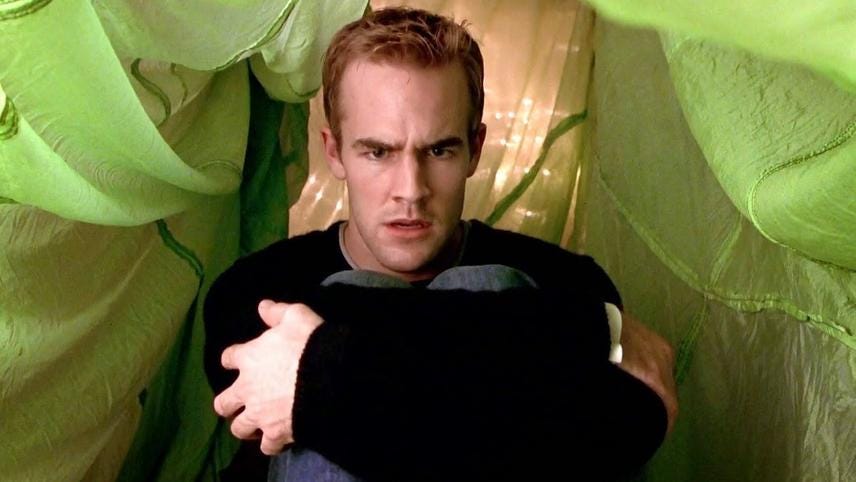
“Typical,” his character, Sean Bateman, in 2002’s THE RULES OF ATTRACTION would have said, with equal parts disdain for the world as a whole and himself in particular.
Though he was best known to the world as Dawson Leery, Van Der Beek also starred in two of the most influential films of my teens/twenties: VARSITY BLUES and THE RULES OF ATTRACTION. In both movies, neither of which were conventional successes but are now firmly established cult films with passionate followings, he was able to capture something I was looking for in movies at the time, but rarely witnessing: a kind of virulent, self-destructive sorrow and forlorn longing that many of the young men around me were feeling but were rarely given freedom to express outside of (some, usually not mainstream) music. An angry young man myself, but also a sensitive and romantic one, I wanted characters that felt masculine without being macho, empathic without being soft. Sean Bateman in RULES OF ATTRACTION and Jon Moxon in VARSITY BLUES were both bullseyes.
Since neither film would be taken seriously till much later (RULES is now considered a masterwork in some circles where such considerations are actually respected), the craftsmanship of Van Der Beek’s performances went largely under appreciated even by people who liked the films as a whole (and in the case of RULES he is flanked by both a solid ensemble and two equitably but perhaps more obviously solid turns by Shannyn Sossamon and Ian Somerhalder). In both roles Van Der Beek was able to walk, with real sensitivity, the fine line that often separates a charming asshole from a disenchanted romantic, pulling off truly edgy performances where it was essential for the audience to connect to characters they would probably normally hate. With his trademark smirk that illuminated his eyes AND his remarkable ability to suddenly erase all traces of emotion from his face, Van Der Beek could bounce between lovable and intimidating in a way that looked effortless and felt authentic. As Mox he used this to elevate a rebellious kid into an oppressed intellectual terrified his potential will never be realized, while with Sean he turned a role that could easily have been just a womanizing bully, into an achingly vulnerable but emotionally inept prodigal caving under his own archetype. In both movies what works most of all is that you watch Van Der Beek’s characters and think: I know this guy. And you do. You know this guy, you fall in love with this guy, you drink with this guy, you chase tail with this guy, you get into fistfights with this guy, and you forgive this guy, because this guy is you.
“He was a new kind of Angry Young Man for a more sensitive generation that was exploring what Any Young Man could be,” I wrote on Facebook in my first attempt at an obituary for this heartthrob of another era. “Sometimes I think half the plays I’ve written, are just me trying to capture the way he says ‘Your name is Lauren,’ in THE RULES OF ATTRACTION.”
“I can’t think of the last time a celebrity death got me this down,” my best friend said on the phone last night.
“Well, when’s the last time one died who was like… our age, you know?” I replied, thinking about how sad I was when Adrienne Shelley was murdered in 2006. Though she was 40 at the time, and I was 27, I remember having a similar sense of “she was robbed!” What’s different this time is how I have to keep reminding myself that even if Van Der Beek was robbed, I haven’t been yet. I mean, I’m still here. I still have unrealized potential that may yet be realized. Right?
“The thing is, I was Dawson Leery,” my best friend was saying, as my mind spiraled somewhere else. “I was that dreamy writer kid who wanted to make movies and tell stories and stay up all night talking to people. I made stupid mistakes and fell in love with all my friends and lost track of them and lost myself, just like he did, and I found my way back, just like he did.”
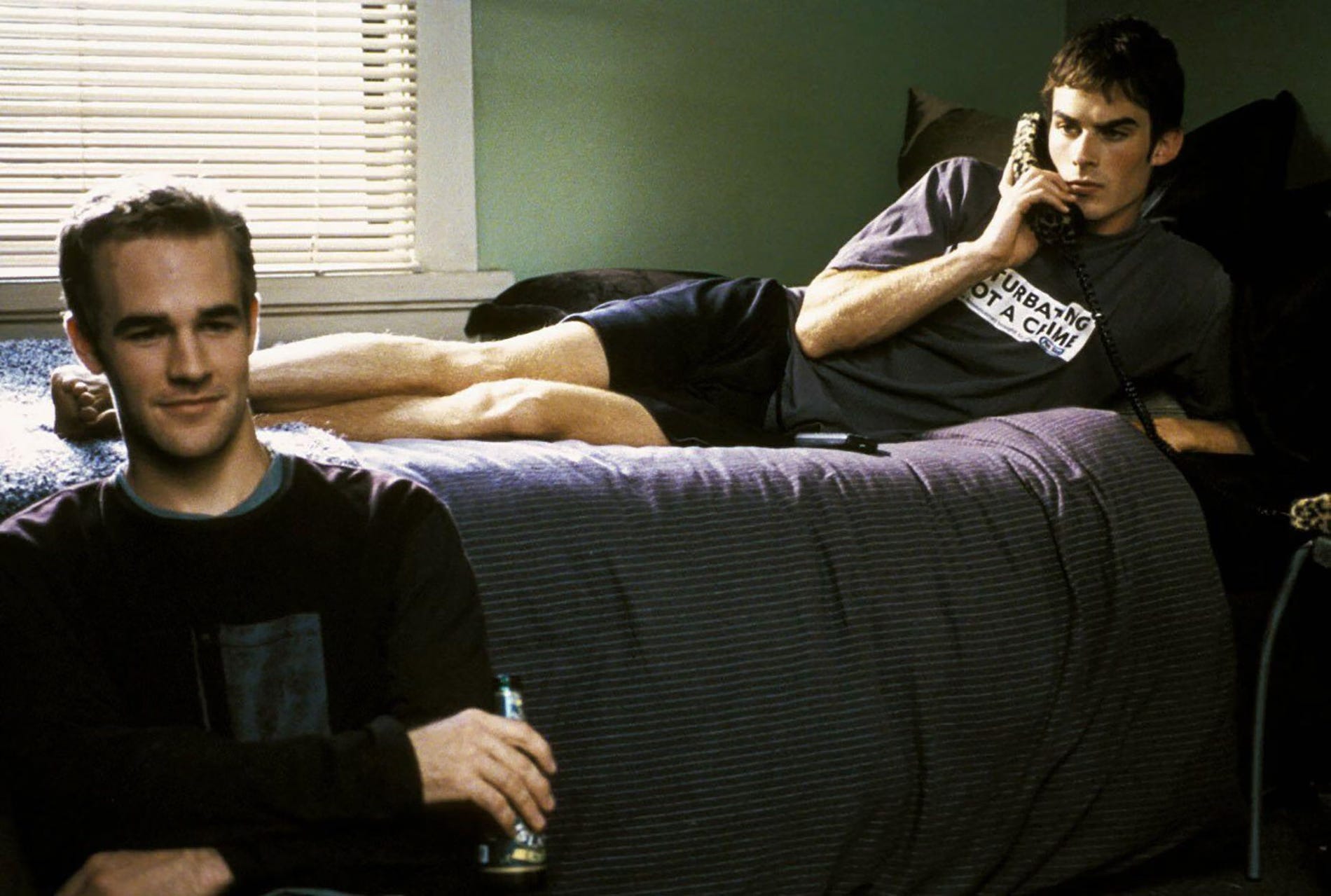
“And I was Paul Denton,” I said, thinking of the boy who falls in love with Sean Bateman in RULES OF ATTRACTION, and whose desperate loneliness only makes Bateman more aware of his own. It’s a tension beautifully realized by Van Der Beek and Somerhalder (who plays Paul) in Roger Avary’s film, and echoes with the deep sadness of their far more explicit relationship in the Bret Easton Ellis novel that was the source material. That novel, which I read in 2001, helped me let go of so much personal drama from college, where I’d both been Paul, and dated Paul. When a year later the film came out, I even dragged both my college boyfriends (who also lived in San Francisco) to see it, though neither cared much for it at the time. Rarely do we enjoy the image displayed in the mirror held up to us by someone else. So even if I wasn’t Sean Bateman, I’d certainly loved Sean Batemen. Anyway, Paul is pretty much just Sean but gay, both scared of the world and looking for someone to hide with. Or explore.
“And now we’re just two middle aged guys on the phone,” my best friend finished, before realizing it was 1 AM his time, and he had kids to make breakfast for in the morning.
“Thanks for writing about him,” he said, just before the line went dead.
*************************************************************************************************************
Hello!
Thank you for reading!
So, in a moment of just, fuck it, I’ll give it a try, I am finally doing
that thing people keep saying I should do and giving you the chance to support my writing.
If you would like to help keep this middle-aged single writer turned food equity coordinator/usher/online content creator/social media manager in the black, I accept Zelle (it’s my phone number), PayPal (@stuartbousel), or CashAp ($Bousel) and I leave it up to you to decide what to give.
You can also get a paid subscription to my Substack. I offer multiple options- two year, one year, and month to month subscriptions. All of them help with my month to month lease.
Obviously, I’m not going to put anything behind a paywall and I’m honored you read anything I write at all. I’m going to try to write something here every Sunday/Monday, around this time, and if you have thoughts or feelings you’d like to share with me to write about I’d love that.
And in case this isn’t clear: this site is not intended to be a news source. And though it may veer into memoire I admit that if it makes for a better story, I may play a little fast and loose with “the facts” so take everything with a grain of salt. Reviews and culture discussions included, any views I present here which are not cited otherwise, are my own, and I do not speak on behalf of any organization or person but myself.
Be well. Reach out. You are a light.
Stuart
I watched the split-screen sequence from "Rules of Attraction" you linked to here, and I was amazed at how easy I found it to just watch James Van Der Beek the whole time and hardly look at Shannyn Sossamon at all (and I don't think it's *just* because commemorating Van Der Beek is the focus of this post). I didn't know how much the camera loved him.
I had a great rehearsal, but I’m not sure that reading this wasn’t the highlight of my day. Thanks, Stuart.